
In the rain-drenched mountain corridors of the Western Ghats—from the wet ridge crests of Lakkidi and Meppadi in Wayanad (receiving over 4,500 mm of annual precipitation) to the cloud-covered slopes of Chinnakanal and Devikulam in Munnar, and the wind-beaten heights of Vagamon and Idukki—the Southwest Monsoon is both a major tourist attraction and a critical test of structural engineering.
Thousands of travelers pay premium tariffs of ₹12,000 to ₹18,000 per night specifically to experience “monsoon tourism”: watching cloudbursts sweep across tea valleys from the comfort of a warm, panoramic chalet.
However, in poorly engineered hillside chalets, a heavy July cloudburst quickly turns an idyllic vacation into an acoustic ordeal:
The “Tin Drum” Resonance (78 dB to 85 dB): When raindrops falling at terminal velocity (8 to 9 m/s) strike a corrugated metal roof (color-coated GI, Galvalume, or aluminum standing seam), the thin metal skin acts as an acoustic amplifier. Interior noise levels surge past 80 decibels—equivalent to standing next to a running diesel generator or heavy traffic. Guests cannot hold a normal conversation, watch television, or sleep.
The Rattling Clay Tile Hazard: Traditional interlocking Mangalore clay tiles are brittle and heavy ($45\text{ to }55\text{ kg/m}^2$). Under 100 km/h monsoon wind shears, tiles rattle loudly against timber battens, crack, and shift out of alignment, causing persistent water leaks directly into ceiling cavities.
Thermal Sweating & Condensation Drips: Single-skin metal roofs cool rapidly under cold rainwater, while the indoor living space remains warm. This thermal bridge triggers severe condensation on the underside of the sheet, causing indoor “rain” that stains ceiling paneling and rots structural frames.
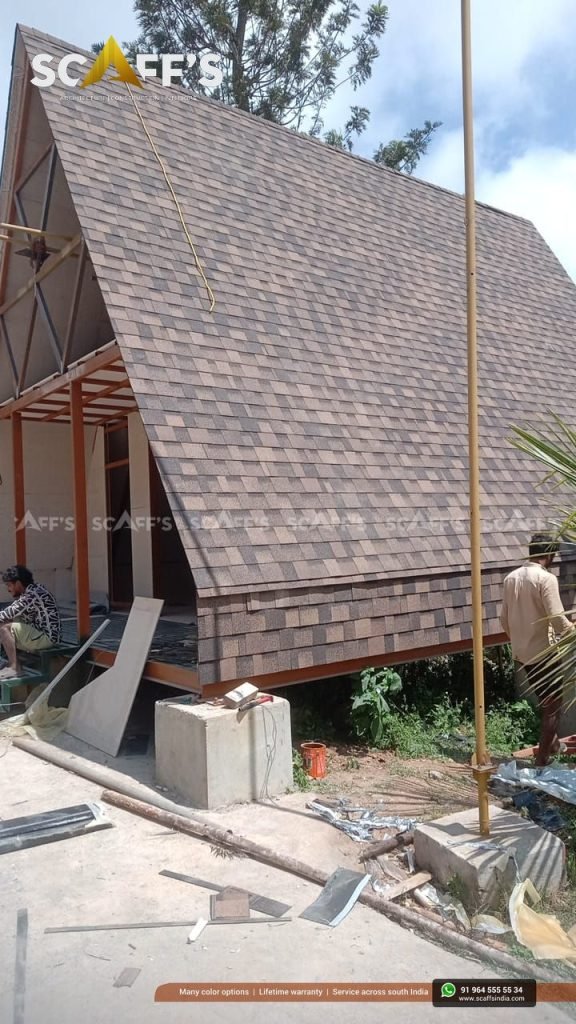
At Scaffs India, we engineer our chalet envelopes to deliver five-star acoustic isolation. By combining imported multi-layered architectural shingles, self-adhering SBS elastomeric membranes, high-density inorganic Bison boards, and spun-basalt Rockwool cores, our 5-tier roof sandwich dampens deafening 78 dB cloudbursts down to a library-quiet 38 dB.
1. The Physics of Rain Impact Acoustics: Sound Transmission Class (STC) & Damping
Rain noise on a roof is structural impact noise governed by kinetic energy transfer:
A monsoon cloudburst dropping 80 mm to 100 mm of water per hour unleashes millions of 3 mm to 5 mm raindrops hitting the roof envelope every minute.
When a drop hits a rigid, elastic material like sheet metal, nearly 100% of that kinetic energy converts into mechanical vibrations that radiate inward as airborne sound waves:
[ ROOF IMPACT SOUND TRANSMISSION COMPARISON ]

  CONVENTIONAL METAL ROOF (Single Skin GI / Galvalume):
  Rain Impact (Kinetic Energy) ──► Metal Skin Vibrates ──► Acoustic Radiation
  ═════════════════════════════════════════════════════════════════════════════
  Acoustic Reading: 78 dB – 84 dB (Intolerable drumming; sleep impossible)

  SCAFFS INDIA 5-TIER COMPOSITE ENVELOPE:
  Rain Impact ──► Ceramic Granules ──► Viscoelastic SBS Bitumen ──► Dense Bison Board
  ═════════════════════════════════════════════════════════════════════════════
  Acoustic Reading: 36 dB – 39 dB (Whisper-quiet ambient; gentle muffled murmur)
To achieve acoustic comfort, an envelope requires three distinct physical mechanisms working in series:
Surface Impact Decoupling (Viscoelastic Damping): Breaking the kinetic force of the droplet before it can excite the structural deck.
Mass-Law Sound Barrier: Providing dense physical mass ($> 20\text{ kg/m}^2$) to block acoustic waves from penetrating the structure.
Cavity Absorption: Dissipating residual sound energy through friction within a fibrous, open-cell insulation core.
2. The Roofing Material Showdown: Technical Performance Comparison
Choosing the right roofing material for an equilateral A-frame on a mountain stilt chassis requires balancing acoustic damping, dead weight, wind uplift resistance, and long-term maintenance:
| Performance & Engineering Metric | Corrugated Color-Coated Metal Sheets | Interlocking Mangalore Clay Tiles | Imported Architectural Shingles (IKO / BP Canada) |
| Monsoon Rain Noise (Interior dB) | 78 dB – 84 dB (Deafening drum effect) | 62 dB – 68 dB (Moderate clatter & rattle) | 36 dB – 39 dB (Library-quiet whisper) |
| Structural Dead Mass per $m^2$ | $5\text{ to }7\text{ kg/m}^2$ (Very lightweight) | $45\text{ to }55\text{ kg/m}^2$ (Extremely heavy dead load) | $11\text{ to }13\text{ kg/m}^2$ (Optimized structural mass) |
| High-Wind Uplift Rating | Poor; screws tear through sheets at 90 km/h | High risk; loose tiles dislodge at 75 km/h | ASTM D3161 Class F (Certified up to 210 km/h) |
| Thermal Conductivity ($k$-value) | Very High ($k = 50\text{ W/m}\cdot\text{K}$; intense heat/cold) | Moderate ($k = 0.8\text{ W/m}\cdot\text{K}$) | Very Low ($k = 0.16\text{ W/m}\cdot\text{K}$; superior insulation) |
| Watertight Integrity on 60° Pitch | Capillary leaks around exposed screws | Leaks under wind-driven horizontal rain | 100% Watertight (Fused thermal self-seal strip) |
| Stilt Foundation Impact | Minimal column sizing required | Demands massive reinforced pillars | Ideal load-to-strength ratio for stilt chassis |
| Algae & Moss Resistance | Poor; edges rust; paint chalks in 5 yrs | Highly porous; turns black with mold | Copper-infused ceramic granules inhibit algae |
| Factory Material Warranty | 5 to 7 Years (Limited paint warranty) | None (Breakage prone) | 25 to 30+ Year International Manufacturer Warranty |
3. Deconstructing the Scaffs India 5-Tier Acoustic & Thermal Sandwich
Our roof envelope is engineered as a laminated composite system where each layer addresses a specific acoustic frequency:
[ SCAFFS INDIA 5-TIER ENVELOPE CROSS-SECTION ]

  EXTERIOR ENVIRONMENT (100 mm/hr Monsoon Cloudburst / 120 km/h Ridge Wind)
  ─────────────────────────────────────────────────────────────────────────
  ▼ [TIER 1] IKO DYNASTY / BP CANADA ARCHITECTURAL SHINGLES
    • Ceramic-coated stone granules scatter droplet kinetic energy
    • Heavy fiberglass-reinforced asphalt core provides primary viscoelastic damping
  ─────────────────────────────────────────────────────────────────────────
  ▼ [TIER 2] ASTM D1970 SELF-ADHERING SBS WATERPROOF MEMBRANE
    • 1.5 mm thick rubberized elastomeric bitumen layer
    • Eliminates high-frequency vibration transfer; seals around nail shanks
  ─────────────────────────────────────────────────────────────────────────
  ▼ [TIER 3] 16 mm INORGANIC BISON CEMENT-BONDED PARTICLE BOARD
    • Dense acoustic mass ($1,300 kg/m³$) blocks mid-frequency airborne noise
    • Class 1 fire rating; non-combustible, zero-rot substrate
  ─────────────────────────────────────────────────────────────────────────
  ▼ [TIER 4] 50 mm HIGH-DENSITY SPUN-BASALT ROCKWOOL (48 kg/m³)
    • Open-porous basalt fiber web traps and absorbs low-frequency sound reverberations
    • Exceptional thermal insulation ($k = 0.034 W/m·K$); melting point > 1,000°C
  ─────────────────────────────────────────────────────────────────────────
  ▼ [TIER 5] 12 mm KILN-DRIED RUSSIAN PINE INTERIOR CEILING PLANKS
    • Micro-porous natural wood grain breaks internal room sound echoes
    • Treated with breathable hardwax oils; warm 2700K timber aesthetic
  ─────────────────────────────────────────────────────────────────────────
  INTERIOR SUITE: 38 dB Ambient Tranquility (Warm, Quiet, Five-Star Luxury)
Tier 1: Kinetic Dissipation (Architectural Shingles): The textured surface of ceramic-coated mineral stone granules on imported IKO or BP Canada architectural shingles acts as millions of microscopic shock absorbers. Unlike smooth metal sheets where droplets strike flat surfaces, the mineral granules shatter raindrops on contact, diffusing their kinetic energy.
Tier 2: Viscoelastic Damping (ASTM D1970 SBS Membrane): Beneath the shingles, a continuous sheet of self-adhering SBS (Styrene-Butadiene-Styrene) modified bitumen acts as a viscoelastic dampening pad. Similar to acoustic deadening mats applied inside luxury car doors, this rubberized layer converts mechanical vibration into harmless low-level heat energy, preventing structural vibrations from entering the deck.
Tier 3: The Dense Mass Barrier (16 mm Bison Board): Under the acoustic Mass Law, sound transmission loss is directly proportional to surface density. The 16 mm Bison cement-bonded board provides an inorganic mass of $21\text{ kg/m}^2$. This high-density barrier blocks mid-frequency sound waves from penetrating into the rafter bays.
Tier 4: Cavity Absorption (Spun-Basalt Rockwool): Any residual acoustic energy that passes through the Bison board enters the structural rafter cavities, which are packed with 50 mm dense Rockwool batts ($48\text{ kg/m}^3$). The intertwined basalt volcanic fibers trap sound waves in microscopic air pockets, boosting the total roof sound transmission rating to STC 44.
4. Thermal Comfort & Anti-Sweat Condensation Prevention
Acoustic insulation provides an equally vital thermodynamic benefit: stopping ceiling condensation and heat loss.
During July downpours in Munnar or Vagamon, outdoor temperatures drop to 12°C while indoor heating elevates room temperatures to 21°C:
The Metal Sweating Problem: A single metal roof skin quickly matches the cold rainwater temperature. When warm, humid indoor air rises and contacts the freezing underside of the metal sheet, water vapor condenses rapidly into droplets. Over weeks, this condensation drips into light fixtures and rots wall battens.
The Composite Thermal Break: In the Scaffs India envelope, the 50 mm Rockwool core ($R\text{-value } \approx 1.5\text{ m}^2\text{K/W}$) completely separates the cold exterior shingles from the warm interior pine planks. The interior ceiling surface remains warm (19°C to 20°C), staying well above the indoor dew point. Ceiling sweating is eliminated without running energy-draining electric dehumidifiers.
5. Weight Optimization on Sloping Stilt Foundations
On steep 25° to 35° mountain contours in Meppadi or Chinnakanal, every metric ton of dead load added to the roof compounds foundation costs:
[ ROOF DEAD WEIGHT VS. FOUNDATION STEEL DEMAND ]

  CLAY TILE ROOF SYSTEM:
  45 kg/m² x 160 m² Roof Area = 7.2 Metric Tons (Roof Dead Load Alone)
  ═══════════════════════════════════════════════════════════════════►
  Requires oversized steel rafters (ISMB 200), thicker foundation stilts,
  and deeper concrete footings to resist seismic and slope sliding forces.

  SCAFFS INDIA SHINGLE SYSTEM:
  12 kg/m² x 160 m² Roof Area = 1.9 Metric Tons (73% Lighter)
  ═══════════════════════════════════════════════════════════════════►
  Allows lean, high-efficiency structural steel hollow sections (RHS 150x75x4.5 mm),
  reducing foundation steel costs while achieving superior wind and seismic safety.
By cutting total roof weight by over 5 metric tons compared to clay tiles, our chalets place far less strain on elevated stilt columns. This low center of gravity enhances seismic stability under IS 1893 and allows chalets to be safely erected on narrow granite rock pins over steep slopes without requiring massive concrete retaining works.
Acoustic Performance Comparison: The 100 mm/hr Downpour Test
| Acoustic Metric | Uninsulated Metal Roof | PUF Panel Metal Roof (50 mm) | Scaffs India 5-Tier Shingle Envelope |
| Rainfall Noise Level | 82 dB (Loud shouting required) | 64 dB (Distracting hum) | 38 dB (Gentle background whisper) |
| Sound Transmission Class (STC) | STC 24 | STC 32 | STC 44 (High luxury hospitality grade) |
| Wind Gust Noise at Eaves | Whistling / metal rattling | Metallic vibrations | Solid, silent aerodynamic deflection |
| Impact Perception | Harsh, metallic ringing | Dull drumming | Soft, muffled, natural acoustic texture |
| Guest Review Impact | Negative complaints about lost sleep | Neutral | Consistently praised for cozy, restful ambience |
Turnkey Envelope Engineering with Scaffs India
Whether you are developing a boutique plantation retreat in Wayanad, high-tariff honeymoon suites in Munnar, an open-ridge eco-resort in Vagamon, or an off-grid sanctuary in Idukki, Scaffs India engineers every building envelope for uncompromising weather protection and quiet comfort:
Full acoustic profile modeling and microclimate rainfall intensity assessments.
Precision structural steel space-chassis fabrication with zero thermal bridging.
16 mm inorganic Bison cement-bonded board sheathing and full-deck ASTM D1970 elastomeric waterproofing.
50 mm high-density spun-basalt Rockwool acoustic insulation cores.
Direct authorized distribution and certified installation of imported IKO and BP Canada architectural roofing shingles backed by 25+ year warranties.
Give your resort guests the ultimate mountain experience: watching the dramatic power of a Western Ghats cloudburst from an interior that remains warm, dry, and whisper-quiet.
Contact our architectural and structural engineering team at Scaffs India to schedule an on-site property evaluation, inspect roofing material cutaways, and receive an itemized turnkey proposal tailored to your land.