
For resort operators and vacation home owners across the Western Ghats—whether managing hillside villas in the mist-saturated gaps of Chinnakanal and Kanthalloor in Munnar, the high-rainfall coffee tracts of Meppadi and Vythiri in Wayanad, or the storm-swept ridges of Vagamon and Idukki—the true cost of ownership is rarely the initial construction budget.
It is the relentless annual operating expense (OPEX) of monsoon repairs.
In conventional mountain hospitality, July and August do not just bring torrential rains; they trigger a predictable cycle of property degradation:
The Peeling Paint & Black Mold Cycle: Dampness migrating through porous cement plaster causes exterior acrylic emulsions to blister, flake, and turn black with fungal algae within 18 months, requiring continuous scraping and repainting before the high-tariff winter season.
The Musty Cabin Sensation: Uninsulated brick walls and unventilated roof cavities trap humid highland air. Guests check into suites that smell of damp mildew, sparking negative online reviews and demanding continuous dehumidifier operation.
Clogged, Sagging Gutters & Facade Streaking: Conventional metal or PVC rainwater gutters quickly choke with falling pine needles, silver oak leaves, and forest debris. Overflowing gutters dump concentrated sheets of dirty water down walls and wash out landscaped paths below.
Displaced Roof Tiles & Hidden Leaks: Interlocking clay tiles or tin sheets rattle, shift, and develop rust around screw penetrations under 100 km/h wind gusts, resulting in internal ceiling water stains and rotted timber rafters.
Over a 10-year holding period, maintaining a traditional masonry villa or raw timber cottage in Kerala’s hill stations routinely drains ₹18,00,000 to ₹28,00,000 in recurring upkeep, labor, and lost room revenue.
At Scaffs India, we eliminate the mountain maintenance cycle through materials science and passive drainage geometry. Explore our turn-key A-frame resort solutions to see how our inorganic envelopes, zero-gutter drip lines, and self-cleaning stone-coated shingles deliver a low-maintenance exterior built for high-rainfall environments.
1. The Concrete Degradation Mechanism: Why Hill Tracts Destroy Masonry
To eliminate maintenance, one must understand why traditional building materials fail in regions receiving 3,500 mm to 4,500 mm of annual rainfall:
[ CONVENTIONAL MASONRY DEGRADATION CYCLE ]

  CONTINUOUS MONSOON RAIN (95% Relative Humidity)
  ─────────────────────────────────────────────────────────────
         │
   [ POROUS BRICK & PLASTER ] ──► Absorbs capillary moisture
         │
   [ THERMAL CYCLING ] (6°C Cold Nights vs. 25°C Sun Peaks)
         │
         ├── Micro-cracks form across exterior cement plaster
         ├── Internal efflorescence (salts push paint off walls)
         └── Fungal spores colonize damp organic binder layers
         │
  ─────────────────────────────────────────────────────────────
  RESULT: Flaking paint, damp interior odor, and yearly repainting bills
Capillary Moisture Migration: Clay bricks and cement plaster are porous. During prolonged four-month monsoons, hydrostatic pressure pushes water through microscopic capillaries. When dry winter weather arrives, migrating salts crystallize beneath paint films (efflorescence), causing white powdering and flaking paint.
Thermal Shock on Rigid Joints: High-altitude locations experience sharp day-to-night temperature swings (up to 18°C differentials). Rigid brick masonry and concrete roof slabs expand and contract against each other, creating hairline fracture lines along ceiling joints where rain penetrates invisibly.
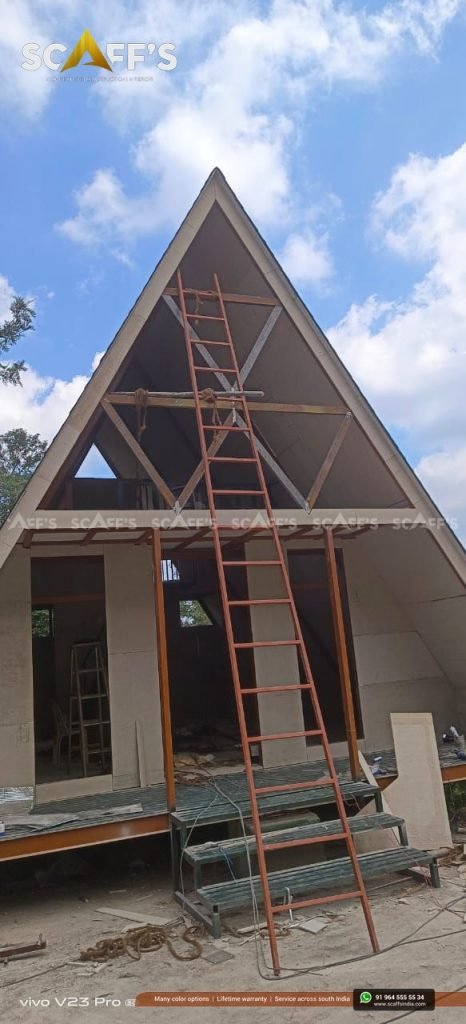
The Dry-Assembly Solution: Scaffs India’s chalets utilize a bolted structural steel space-chassis sheathed with 16 mm inorganic Bison cement-bonded boards. Because the envelope contains zero wet mortar or porous plaster, it cannot absorb capillary water, crack under thermal cycling, or harbor fungal mold spores. Review our substrate properties in our guide to termite-proof and anti-rot engineering.
2. The Zero-Gutter Drip-Line: Eliminating Clogged Eaves & Water Cascades
A common design failure on high-altitude forest plots is installing standard horizontal eaves gutters. On estates bordered by silver oaks, eucalyptus, and wild mountain bamboo, gutters collect kilograms of wet organic matter within days, rotting joints and overflowing:
[ ZERO-GUTTER GRAVEL DRIP-LINE SCHEMATIC ]

                      [ 60° STEEP A-FRAME ROOF ]
                     (IKO Shingles + ASTM D1970 Membrane)
                                  \
                                   \  Rainfall accelerates down slope
                                    \ (Zero horizontal gutter to clog)
                                     \
                                      ▼
                        [ EXTENDED EAVE DRIP EDGE ]
                        (Heavy-gauge aluminum drip flashing)
                                      │
  FREE-FALL CLEARANCE                 │ High-velocity water drops cleanly
  (1.5 m to 2.5 m above ground)       │ away from cabin wall chassis
                                      │
                                      ▼
  ─────────────────────────────────────────────────────────────────────────
            [ SUB-GRADE CRUSHED GRANITE DRIP APRON ]
            ├── 300 mm deep trench filled with 40 mm clean granite metal
            ├── Non-woven geotextile filter fabric wrap
            └── Perforated HDPE drainage pipe routing water to storage cistern
  ─────────────────────────────────────────────────────────────────────────
The Clean Break: We completely eliminate horizontal eaves gutters. Instead, the steep 60° roof pitch accelerates rainwater downward, discharging it cleanly off an engineered aluminum drip-edge flashing projecting 150 mm past the lower chassis.
The Gravel Impact Apron: Directly beneath the roof overhang along both sides of the cottage, we excavate a 400 mm wide, 300 mm deep ground trench backfilled with angular crushed granite aggregate (40 mm metal).
Kinetic Energy Dissipation: Falling water hits the coarse stone bed, dissipating its kinetic energy instantly without splashing mud back onto the elevated stilt chassis or eroding topsoil around foundation pillars.
Subsurface Collection: A perforated HDPE pipe at the bottom of the gravel trench collects the clean water and routes it via gravity into the resort’s central high-altitude rainwater harvesting reservoirs.
3. Self-Cleaning Exterior Cladding: The Ceramic Stone Granule Shield
Conventional painted surfaces require chemical washing and recoating every two years. Our exterior cladding requires zero painting across its multi-decade design life:
| Cladding Performance Metric | Exterior Acrylic Emulsion on Plaster | Color-Coated Corrugated Metal Sheets | Imported Architectural Shingles (IKO / BP Canada) |
| Coating Longevity | Peels and fades within 18 to 24 months | Paint chalks and oxidizes in 5 to 7 years | 25 to 30+ Year factory material warranty |
| Algae & Lichen Resistance | Poor; organic binder feeds black algae | Moderate; algae gathers in fastener pockets | Algae-resistant ceramic mineral granules |
| Fastener Corrosion Risk | N/A | High; rubber washers dry-rot and leak | 100% concealed fasteners sealed under SBS bitumen |
| Cleaning Requirement | Manual pressure washing and scraping | Regular repainting to prevent edge rust | Naturally self-cleaning via seasonal monsoon rain |
| UV Resistance at 1,500 m | Severe UV breakdown and color fading | Fades, chalks, and heats underlying rooms | Inorganic stone granules impervious to high UV |
Algae-Resistant Chemistry: Premium architectural shingles like IKO Dynasty incorporate specialized copper-containing mineral granules. In the presence of rainwater, these granules release microscopic trace ions that prevent algae, moss, and black cyanobacteria from taking root on the roof.
Self-Scouring Surface: The natural kinetic wash of heavy monsoon showers scours dust, tree pollen, and atmospheric soot off the textured stone face, leaving the roof looking clean as soon as the sun breaks through. Compare complete envelope lifecycles in our roofing material showdown.
4. Interior Wood Preservation: Micro-Porous Breathability vs. Peeling Varnish
Inside the chalet, the sensory signature is natural timber. Yet traditional builders frequently coat interior wood with thick polyurethane (PU) or melamine varnishes that fail in highland dampness:
The Varnish Blister Trap: Wood is a hygroscopic material that absorbs and releases ambient vapor. When sealed under a rigid, plastic-like varnish, micro-moisture trapped within the wood cells cannot escape. As temperatures shift, vapor pressure blisters the clear-coat, leaving cloudy white patches and peeling flakes that require chemical stripping.
Micro-Porous Hardwax Oils: We treat our kiln-dried interior Russian pine paneling with non-toxic, plant-based hardwax oils. These oils bond molecularly with the cellulose fibers deep within the wood pores while leaving the surface open to breathe.
Effortless Spot Refurbishment: If a guest luggage scrape or high-traffic area shows wear after three years, housekeeping staff do not need to sand down an entire wall. A simple wipe-down with a maintenance wax cloth restores the rich, golden satin luster in 15 minutes, with zero chemical odor and zero room downtime.
5. 10-Year Facility Cost Audit: Conventional Villa vs. Scaffs India Chalet
The following cost model evaluates the cumulative 10-year facility maintenance expenditure for a 550 sq ft commercial resort unit operating in Munnar or Wayanad:
| Maintenance & Facility Operation (10-Year Horizon) | Conventional Brick & Mortar Villa | Scaffs India Engineered A-Frame Chalet | Net 10-Year Operational Savings |
| Exterior Facade Painting (Every 2 Years) | ₹2,80,000 (5 cycles of scraping, primer, paint) | ₹0 (Stone-coated shingles need zero paint) | ₹2,80,000 Saved |
| Roof Tile Alignment & Waterproofing Repairs | ₹1,90,000 (Resetting loose tiles, sealants, cement) | ₹0 (Interlocking shingle tabs; zero leakage) | ₹1,90,000 Saved |
| Gutter Cleaning & Debris Removal | ₹60,000 (Bi-monthly labor over 10 years) | ₹0 (Zero-gutter gravel apron design) | ₹60,000 Saved |
| Internal Plaster Crack & Damp Remediation | ₹2,20,000 (Patching cracks, damp sealers) | ₹0 (Inorganic Bison board; zero damp transfer) | ₹2,20,000 Saved |
| Interior Wood Sanding & Re-Varnishing | ₹1,50,000 (Chemical strip & lacquer every 3 yrs) | ₹25,000 (Simple hardwax oil wipe-downs) | ₹1,25,000 Saved |
| Lost Booking Revenue During Maintenance Downtime | ₹6,00,000 (15 days offline per year @ ₹8,000 ADR) | ₹0 (Zero seasonal maintenance shutdowns) | ₹6,00,000 Saved |
| Total 10-Year Facility Maintenance Expense | ₹15,00,000 – ₹22,00,000 | ₹25,000 – ₹50,000 | ₹14,75,000 – ₹21,50,000 Net Savings |
By eliminating ongoing facade painting, roof repairs, and room downtime, developers save an amount nearly equal to 50% of the chalet’s original construction capital over a single decade of operation. Review our initial capital allocations in our turnkey cost breakdown and BOQ analysis.
6. Seasonal Property Turnaround: The 48-Hour Reset Protocol
For resort operations, speed of seasonal turnaround directly impacts profitability. Transitioning from the wet monsoon season (June–August) into the peak booking winter season (September–January) typically requires weeks of messy civil repair:
[ PROPERTY SEASONAL RESET TIMELINE COMPARISON ]

CONVENTIONAL MASONRY RESORT (15 to 25 Days Downtime):
Day 1–5: Scrape flaking damp exterior plaster
Day 6–10: Apply primer and two coats of exterior paint (weather permitting)
Day 11–15: Replace cracked roof tiles, repair leaking gutters, and dry out rooms
Outcome: High labor bills; rooms blocked from booking calendars during early autumn

SCAFFS INDIA CHALET RESORT (48 Hours Total Reset):
Hour 0–12: High-pressure water rinse of cantilevered WPC decks and glass facades
Hour 13–24: Clean internal window panes and wipe interior pine trims with wax cloth
Hour 25–48: Test thermodynamic hot tubs, light hearth stoves, and welcome check-ins
Outcome: 100% room inventory open for booking on day one of peak season
Instant Pressure-Wash Durability: Our co-extruded WPC composite viewing decks and double-glazed DGU curtain walls can be pressure-washed with clean water without absorbing moisture or scratching finishes.
Continuous Dry-Air Ventilation: Because our chalets utilize engineered passive stack-effect ventilation via baffled apex ridge vents, mountain air circulates continuously even when the cottage is locked between guest visits. The interior remains fresh, dry, and pine-scented year-round, with no musty smell upon arrival.
Turnkey Asset Protection with Scaffs India
Whether you are expanding an established plantation retreat in Wayanad, launching high-tariff honeymoon chalets in Munnar, developing a scenic ridge resort in Vagamon, or creating an off-grid sanctuary in Idukki, Scaffs India provides an engineered building envelope that protects your capital investment over the long term:
Structural steel space-chassis with multi-coat industrial anti-corrosion protection.
Elevated stilt foundations with zero-excavation rock anchoring that prevents ground dampness.
16 mm inorganic Bison cement-bonded boards that eliminate rot, termites, and efflorescence.
Full-deck self-adhering ASTM D1970 waterproof membranes that seal tightly around every fastener.
Direct authorized distribution and certified installation of imported IKO and BP Canada architectural roofing shingles backed by multi-decade warranties.
Build an iconic mountain destination that looks as clean, sharp, and welcoming in year ten as it does on opening day—without spending your operational profits on annual repairs.
Planning a resort or holiday cottage in Kerala’s highlands?
Talk directly with our project engineering and asset management team at Scaffs India to schedule a direct site consultation, review architectural detailing, and receive an itemized turnkey proposal.