
When guests check into an A-frame cabin in Munnar, Wayanad, or Vagamon during the monsoon, their stay is defined by indoor comfort:
Does the rain sound like a gentle background rhythm, or is it a deafening rattle that keeps them awake?
Is the bedroom warm and cozy when nighttime temperatures drop to 8°C outside, or does the mountain chill radiate through the walls?
Are the glass walls crystal clear, or are they fogged up with clammy condensation dripping down the woodwork?
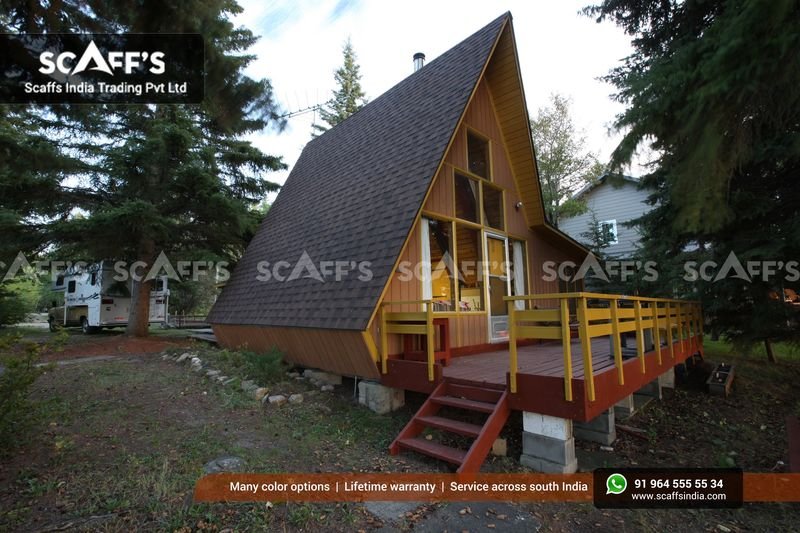
In an A-frame cottage, the sloped roof acts simultaneously as the exterior shell, the ceiling, and the walls. If built with lightweight tin sheets or uninsulated single-ply boards, the cabin turns into an echo chamber in the rain and a refrigerator at night.
At Scaffs India, we engineer our A-frame building envelopes with a multi-layered composite sandwich.
Here is the exact material science and layer-by-layer detailing we use to ensure our cottages remain whisper-quiet in torrential cloudbursts, insulated against mountain cold, and completely free from internal moisture.
The 6-Layer Climate Armor: How the Envelope Is Built
To deliver residential-grade luxury in high-altitude terrain, we construct our sloped roof panels using a precision six-layer composite system:
[ OUTSIDE WEATHER: 100 mm/hr Cloudbursts | 8°C Night Cold | High Humidity ]
                                   │
                                   ▼
[ 1. IKO / BP CANADA ARCHITECTURAL SHINGLES ]  <-- Dense mineral granules deaden rain noise
-------------------------------------------------
[ 2. ASTM D1970 SBS SELF-ADHERING MEMBRANE ]   <-- 100% airtight & watertight rubberized seal
-------------------------------------------------
[ 3. 16 mm BISON CEMENT-BONDED PARTICLE BOARD ]<-- Solid acoustic mass; zero moisture swell
-------------------------------------------------
[ 4. STRUCTURAL STEEL / GLULAM RAFTER CAVITY ] <-- Heavy-gauge framing with thermal breaks
  └── PACKED WITH 50 mm ROCKWOOL (48 kg/m³)     <-- Thermal barrier & sound absorption core
-------------------------------------------------
[ 5. HIGH-PERFORMANCE VAPOR CONTROL MEMBRANE ] <-- Stops indoor humidity from entering framing
-------------------------------------------------
[ 6. NATURAL PINEWOOD / INTERIOR TIMBER CLADDING]<-- Warm, tactile finish with low thermal conductivity
                                   │
                                   ▼
[ INSIDE LIVING SPACE: 22°C Cozy Warmth | Whisper-Quiet Acoustics | Fresh, Dry Air ]
1. Eliminating Monsoon Rain Noise: Why Shingles Outperform Metal
During peak monsoon squalls in the Western Ghats, rainfall intensity frequently exceeds 80 to 100 mm per hour.
The Problem with Metal Roofing: Corrugated GI or aluminum roofing sheets act like drum skins. Raindrops impacting bare metal generate noise levels between 75 and 85 decibels (dB)—comparable to standing next to a running blender or heavy highway traffic. Guests cannot sleep, watch TV, or talk without shouting.
The Shingle Solution: IKO and BP Canada architectural laminated shingles, distributed by Scaffs India, feature a multi-layer fiberglass-asphalt matrix coated with embedded ceramic mineral granules.
The Result: The textured mineral surface breaks the kinetic impact of falling water, absorbing sound vibration before it reaches the structure. Combined with 16 mm Bison board and 50 mm Rockwool insulation, ambient indoor rain sound drops to a soft, muffled 40 to 45 dB, creating the calming cabin ambience guests look for.
2. Temperature Management: Managing Chilly Nights & Midday Sun
Highland locations like Munnar, Kanthalloor, and Ooty experience sharp diurnal temperature swings: bright afternoon sunshine followed by chilly, damp nights.
| Location Climate Condition | Standard Single-Skin Cabin | Scaffs India Multi-Layer A-Frame |
| Monsoon Night (8°C – 12°C) | Rapid heat loss through thin roof; feels drafty, damp, and cold | Heat retention via 50 mm Rockwool; stays warm with minimal indoor heating |
| Summer Midday (28°C – 32°C) | Greenhouse heat buildup under uninsulated roof sheets | Granules reflect radiant heat; baffled apex vent flushes hot air out |
| Relative Humidity (90% – 100%) | Clammy timber, musty smells, mold on wardrobe corners | Breathable vapor barrier keeps indoor air fresh, dry, and balanced |
High-Density Rockwool Core: We pack all rafter bays with 50 mm resin-bonded Rockwool mineral wool insulation ($48\text{ kg/m}^3$). Unlike basic expanded polystyrene (thermocol) which can off-gas and burn, Rockwool is non-combustible, hydrophobic (repels water droplets), and provides excellent thermal resistance (R-value).
Continuous Apex Convective Exhaust: At the cottage peak, we incorporate a continuous, externally baffled ridge vent beneath matching capping shingles. Warm indoor air naturally rises and exhausts through the ridge slot, drawing cool mountain air through low eave vents to maintain continuous, passive air circulation without cold drafts.
3. Preventing Condensation & Glass Fogging
A common issue in cold-climate cabins is sweating walls and fogged-up glass.
When guests take hot showers, brew coffee, or simply breathe inside an enclosed space, warm indoor moisture hits cold exterior surfaces. If unmanaged, this moisture condenses into water droplets, rotting timber framing from the inside out and turning luxury views into cloudy, wet glass:
Double-Glazed Units (DGU) with Argon Gas Fill
The front triangular facade uses double-glazed, toughened glass panels separated by a 12 mm hermetically sealed argon-gas spacer.
The internal gas layer acts as a thermal break, keeping the inner glass pane close to room temperature.
Guests enjoy panoramic valley and sunrise views without foggy glass or cold drafts sitting near the window.
Internal Vapor Barrier Protection
Before installing the interior pine paneling, we lay a continuous, high-performance vapor barrier membrane across the rafters. This prevents indoor humidity from migrating into the insulation cavity, keeping the structural frame bone-dry and extending the lifespan of the interior timber.
Acoustic & Thermal Performance Comparison
| Feature | Low-Cost Tin/Sheet Cabin | Basic Plywood & Shingle Build | Scaffs India Luxury Specification |
| Rain Impact Noise | Loud clatter (75–85 dB) | Moderate thud (55–65 dB) | Whisper-quiet (40–45 dB) |
| Interior Temperature | Drops fast to outdoor levels | Mild insulation loss | Stays comfortably warm (holds 20°C–23°C) |
| Mold & Fungus Risk | High on unbacked timber | High at corners as plywood swells | Zero (Inorganic Bison board + SBS seal) |
| Exterior Fire Rating | Poor (exposed underlays) | Class C (combustible wood base) | Class A Fire Resistant assembly |
| Lifespan in Western Ghats | 4 to 7 years before rust & leaks | 8 to 12 years (requires upkeep) | 25+ years with manufacturer-backed warranties |
Built for Decades of Mountain Weather
Building in the Western Ghats requires materials engineered to handle heavy rainfall, dense fog, and cool highland nights. Compromising on insulation, using unrated sheathing boards, or installing loud metal roofing turns a scenic retreat into a damp, noisy property that struggles with negative guest reviews.
By combining rigid structural steel or glulam timber frames, 16 mm heavy-duty Bison cement-bonded boards, full-deck ASTM D1970 elastomeric waterproofing, and high-density Rockwool acoustic insulation beneath imported IKO and BP Canada architectural shingles, Scaffs India builds A-frame cottages that deliver peaceful, climate-controlled comfort on the inside and weather-tight durability on the outside.
Planning a resort or holiday home in Kerala’s hill stations?
Talk directly with our technical team at Scaffs India to explore our insulation specifications, review 3D layouts, and receive an itemized quote for your site.