
In an A-frame cottage, the roof represents over 75% of the total exterior building envelope. It is not merely an overhead cover; it is your exterior wall, your insulation barrier, and your front-line defense against the elements.
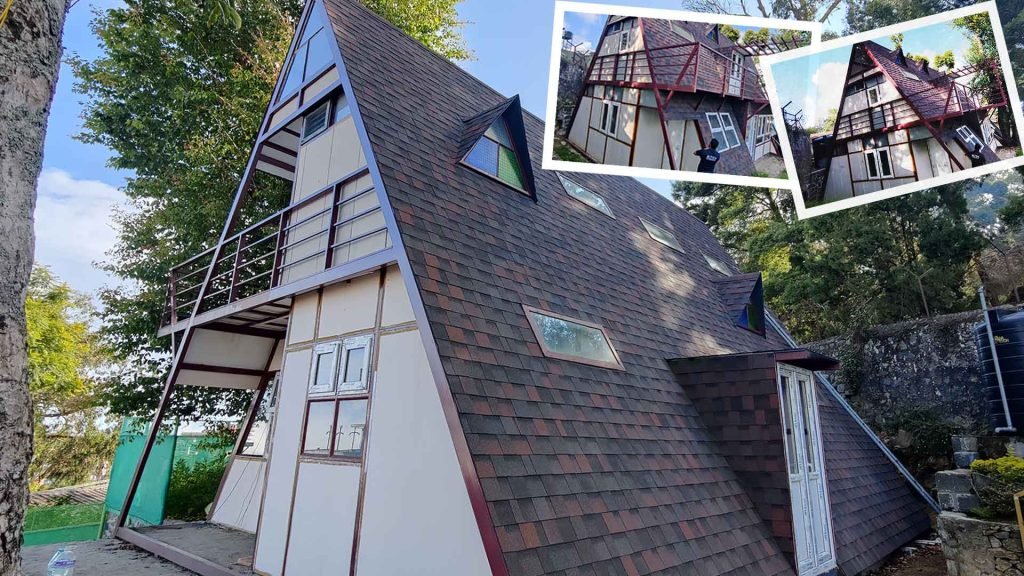
Choose the wrong roofing material in high-altitude hill tracts like Munnar, Wayanad, Vagamon, or Idukki, and the consequences hit your guest ratings and wallet fast:
Deafening rain rattle that makes sleep impossible during 100 mm/hour monsoonal cloudbursts.
Persistent joint leaks and wind-driven water seepage running down interior timber walls.
Rust stains around screw holes, peeling paint, and ugly black algae patches.
Structural weight overloads on steep mountain slopes.
At Scaffs India, we evaluate roofing not just as a finish, but as an engineered system. Here is an honest, head-to-head comparison of the three most common roofing choices for Kerala’s highlands—corrugated metal sheets, traditional clay tiles, and North American architectural shingles—to see which delivers the best comfort, longevity, and return on investment.
The Three Contenders: How They Perform in the Western Ghats
1. Corrugated Metal / Standing Seam Sheets (GI & Aluminum)
Many budget builders reach for corrugated metal sheets because they are cheap to buy and quick to screw down. However, on a luxury A-frame cabin, metal introduces serious operational drawbacks:
The “Tin Shed” Drum Effect: Falling raindrops hitting bare metal generate indoor noise levels between 75 and 85 dB—comparable to running a kitchen blender right next to your bed. Guests checking into a boutique retreat find the noise unbearable.
Internal Sweating (Condensation): High humidity and cold night air cause the underside of metal sheets to sweat, dripping moisture straight onto internal insulation and ceiling timbers.
Corrosion Around Screws: Mountain mist and acidic rain oxidize metal around through-fasteners within 4 to 6 years, leading to rust streaks and loose screws that leak under wind uplift.
2. Traditional Clay & Concrete Roof Tiles
Clay tiles look classic in heritage architecture, but using them on a steep 60° A-frame in the highlands brings major structural risks:
Dangerous Dead Weight: Clay tiles add massive dead weight (40 to 55 kg per square meter). On elevated steel or timber stilts on a steep hill, this requires heavy, expensive substructure reinforcement.
Wind Blow-Offs on Exposed Ridges: Clay tiles rely heavily on gravity and interlocking nibs. On near-vertical 60° slopes exposed to 100 km/h wind gusts in Vagamon or Munnar, tiles shift, chatter, and can slide off, creating hazards.
Moss & Porosity: Porous clay absorbs moisture during continuous monsoon dampness, cultivating black algae, moss, and hairline frost cracks during cold winters.
3. North American Architectural Laminated Shingles (IKO & BP Canada)
Imported architectural shingles from IKO and BP Canada—distributed directly by Scaffs India—are engineered specifically for steep-slope roofs and harsh freeze-thaw-rain cycles:
Whisper-Quiet Rain Acoustics: The multi-layer composite matrix of oxidized asphalt and fiberglass is coated with ceramic-fired mineral granules. The textured stone surface breaks the kinetic energy of raindrops, muting downpours to a gentle 40 to 45 dB background hum.
Zero Rust, Zero Rot: Made of inorganic glass fiber and weathering-grade asphalt, shingles cannot rust, corrode, or rot.
Engineered for High-Pitch Slopes: Installed with our dedicated 6-nail mechanical fastening schedule and polymer hand-tabbing, architectural shingles stay locked in place even under wind speeds up to 175–210 km/h.
Organic Natural Stone Aesthetic: Available in deep charcoal, weathered timber, and slate grey tones, shingles provide a textured, dimensional look that blends seamlessly with surrounding tea estates and forest canopies.
Head-to-Head Comparison Table
| Performance Factor | Corrugated Metal Sheets | Traditional Clay Tiles | Scaffs India Architectural Shingles |
| Installed Weight (Dead Load) | Light (~5–8 kg/m²) | Extremely Heavy (~45–55 kg/m²) | Optimal (~11–13 kg/m²) |
| Acoustic Noise in Heavy Rain | Deafening (75–85 dB) | Moderately loud (60–70 dB) | Whisper-quiet (40–45 dB) |
| Performance on 60° Steep Slope | Fasteners prone to wind tear | High risk of slippage / displacement | Engineered for steep & mansard pitches |
| Corrosion & Rust Risk | High at screw penetrations | Zero corrosion, but absorbs water | 100% Rust-proof and non-porous |
| Wind Resistance Rating | Unrated / Moderate | Prone to tile blow-off in storms | Class F / Class H (Up to 210 km/h) |
| Underlayment System | Often single unsealed felt | Open battens without solid deck | Full ASTM D1970 self-adhering SBS membrane |
| Substrate Decking | Thin purlins / slats | Timber or steel batten grid | 16 mm heavy-duty Bison cement board |
| Manufacturer Warranty | 5 to 7 years (Prone to paint peel) | Limited breakages warranty | 25+ Year multi-decade warranty |
The Complete Scaffs India Weather-Armor Assembly
At Scaffs India, we never nail shingles onto bare timber battens or thin plywood. We build an integrated, multi-layer envelope:
The Structural Base (16 mm Bison Board): A rigid, termite-proof, fire-resistant cement-bonded particle board that will not swell or delaminate in damp mountain fog.
The Waterproof Shield (ASTM D1970 SBS Membrane): A continuous, self-adhering rubberized elastomeric membrane that self-seals around every fastener penetration, creating an airtight, watertight secondary envelope.
The Outer Armor (Architectural Shingles): Dimensional laminated shingles from IKO and BP Canada fixed with six heavy-gauge ring-shank nails and manual polymer tab bonding.
The Baffled Ridge Ventilation: A continuous, UV-stabilized ridge vent along the cottage apex capped with SBS matching shingles, allowing trapped warm air to exhaust naturally while keeping driving rain out.
The Verdict: Why Shingles Deliver the Best Hospitality ROI
If you are building an agricultural tractor shed, corrugated metal sheets are fine. If you are restoring a heritage tiled bungalow on flat ground, clay tiles have their place.
However, if you are investing in a luxury A-frame cottage or boutique resort in Wayanad, Munnar, Vagamon, or Idukki, architectural shingles are the clear winner. They give you the lightweight structural efficiency needed for steep hillside foundations, whisper-quiet rain acoustics for five-star guest sleep, and 25+ years of zero-maintenance durability against Kerala’s relentless monsoons.
Partner with Scaffs India for Turnkey Mountain Construction
Whether you are planning a private vacation chalet in Wayanad, a boutique honeymoon stay in Munnar, an eco-resort cluster in Vagamon, or an off-grid plantation cabin in Idukki, Scaffs India handles your project end-to-end:
Foundation engineering and elevated stilt chassis fabrication tailored to sloped plots.
16 mm Bison board sheathing, ASTM D1970 membrane waterproofing, and panoramic DGU glass facades.
Direct authorized supply and certified installation of imported IKO and BP Canada architectural roofing shingles.
Build an iconic mountain retreat designed to give your guests quiet luxury on the inside and decades of weather-tight protection on the outside.
Ready to choose the right roof for your hillside cottage?
Contact our engineering and project advisory team at Scaffs India to explore shingle samples, review architectural floor plans, and receive an itemized proposal for your site.